

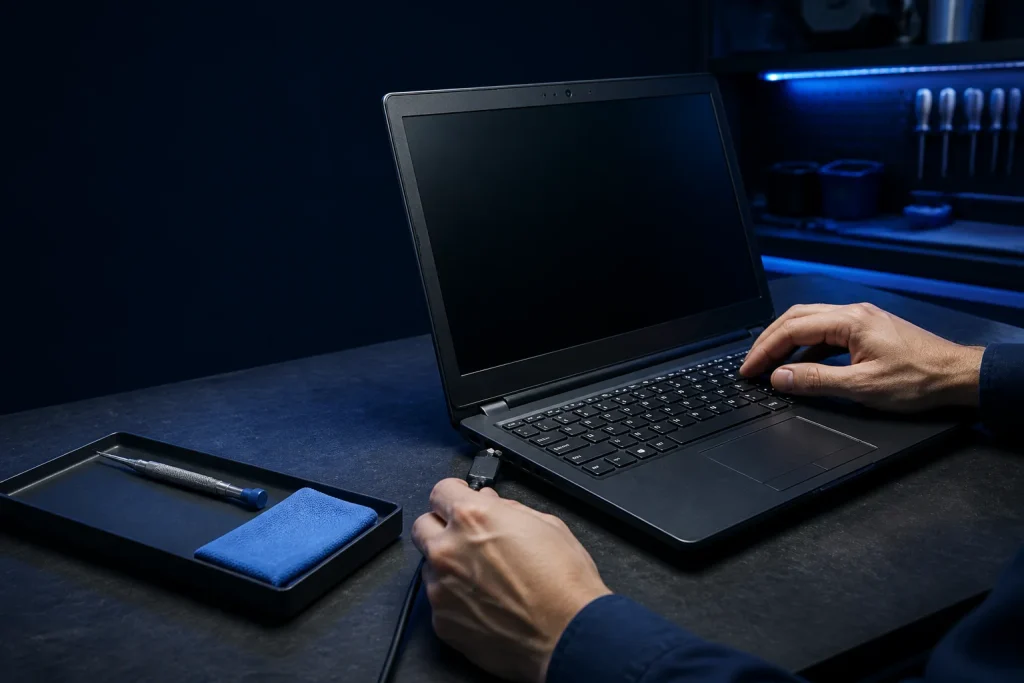
“Used”, “refurbished” and “renewed” get thrown around as if they mean the same thing. They do not. A used laptop is whatever the last owner left behind. A renewed laptop has been taken apart, tested against a fixed standard, repaired where it failed, and rebuilt from a clean install. The difference is the standard — and whether anyone stands behind it afterwards.
Here is what actually happens to a machine between arriving at our workshop and appearing in the shop.
Where the laptops come from
Almost none of our stock comes from individual owners. It comes from corporate refresh cycles: a bank, a consultancy or a government department replaces a fleet on a three-year schedule, and several hundred business-class machines come off lease at once. That matters more than it sounds. Business laptops — Latitudes, ThinkPads, EliteBooks, Surface devices — are built for five to seven years of daily use, so a three-year-old fleet machine has spent less than half its design life on a desk in an air-conditioned office.
It also means the machines arrive in consistent batches. When fifty identical Latitude 5500s land together, we know exactly which parts fail on that model and we stock them before we start.
The 50-point inspection
Every machine goes through the same checklist, regardless of what it cost us or what we expect to sell it for. Nothing is skipped because a laptop “looks fine”. The checks fall into five groups:
- Display — dead and stuck pixels, backlight uniformity, brightness at full output, hinge tension through the full range of motion, and any pressure marks or delamination at the edges.
- Battery — full charge and discharge cycle, measured capacity against the manufacturer’s design capacity, cycle count, charge rate, and a physical check for any swelling.
- Keyboard and trackpad — every key registered individually, key travel and legend wear, trackpad tracking across the whole surface, and both click zones.
- Ports and radios — each USB, HDMI, DisplayPort, Ethernet, audio jack and card reader tested with a live device, plus Wi-Fi throughput, Bluetooth pairing, webcam, microphone and both speakers.
- Speed and stability — SSD health and read/write speeds, RAM tested for errors, and a sustained CPU load test with thermal monitoring to catch dried thermal paste and clogged fans before you do.
Fifty checks sounds like marketing until you watch it happen. It takes a technician most of an hour per machine.
What gets replaced
Anything that fails a check either gets replaced or the machine does not go on sale. In practice the parts we swap most often are batteries below 80% of design capacity, keyboards with worn legends, and thermal paste — which we replace on every single machine regardless of test results, because it costs very little and it is the difference between a laptop that throttles under load and one that does not.
Cracked palm rests, failed hinges and dim panels are rarer, and are usually the reason a machine gets stripped for parts instead of listed.
The software rebuild
The original drive is wiped to a data-destruction standard, not just reformatted, and in most cases it is replaced with a fresh SSD outright. Windows goes on clean, from a licensed image, with current drivers from the manufacturer and no bundled trial software. You get a first-boot setup screen, exactly as you would from a sealed box.
Grading and pricing
Only after all of that does a machine get a cosmetic grade — A, B or C — describing how much wear the shell shows. The grade sets the price. It never affects the inspection, which is identical for every laptop we sell, and it never affects the warranty.
What you actually get
Every certified renewed laptop leaves with a 12-month warranty covering hardware faults, a 10-day return window if it is not what you expected, and a charger matched to the machine. If something fails inside the warranty period, you deal with us directly rather than an overseas support queue.
That is the whole difference. Not a polish and a photo — a standard, applied the same way every time, with someone accountable when it slips.